The basics

What is speed climbing?

Speed climbing is sprinting, vertically: a head-to-head race up a 15-meter wall on a single, standardized route that is identical everywhere in the world. Two climbers, two lanes, one clock. First to slap the buzzer at the top wins. It's the fastest sport in the Olympics, with the men's world record at 4.54 seconds and the women's at 5.99, and the top form of competition is the World Climbing Series.

The wall

One route. 20 hand holds. Memorized by every climber on earth.

What makes speed climbing unique among climbing disciplines is its standardization. In lead and bouldering, every route and problem is different. In speed, the route (designed by route-setter Jacky Godoffe) has been frozen since 2007: the same hand and foot holds, in the same positions, on every internationally certified wall on the planet. That turns speed into a pure performance sport. It's you against the clock, and the clock never changes.

15m
Wall height (a 10m version is used at some youth and regional events)
5°
Overhang, the wall leans back five degrees
20+11
Hand holds and foot holds, in fixed positions
~F6b
Route grade (about 5.10c), the challenge is speed, not difficulty

Timing is electronic and unforgiving: a pressure pad at the base starts the clock and a touchpad at the top stops it, accurate to the thousandth of a second. The wall uses an auto belay, so climbers never need a partner to hold the rope. A fixed route plus a self-braking belay is what makes speed the easiest discipline to start learning on your own.
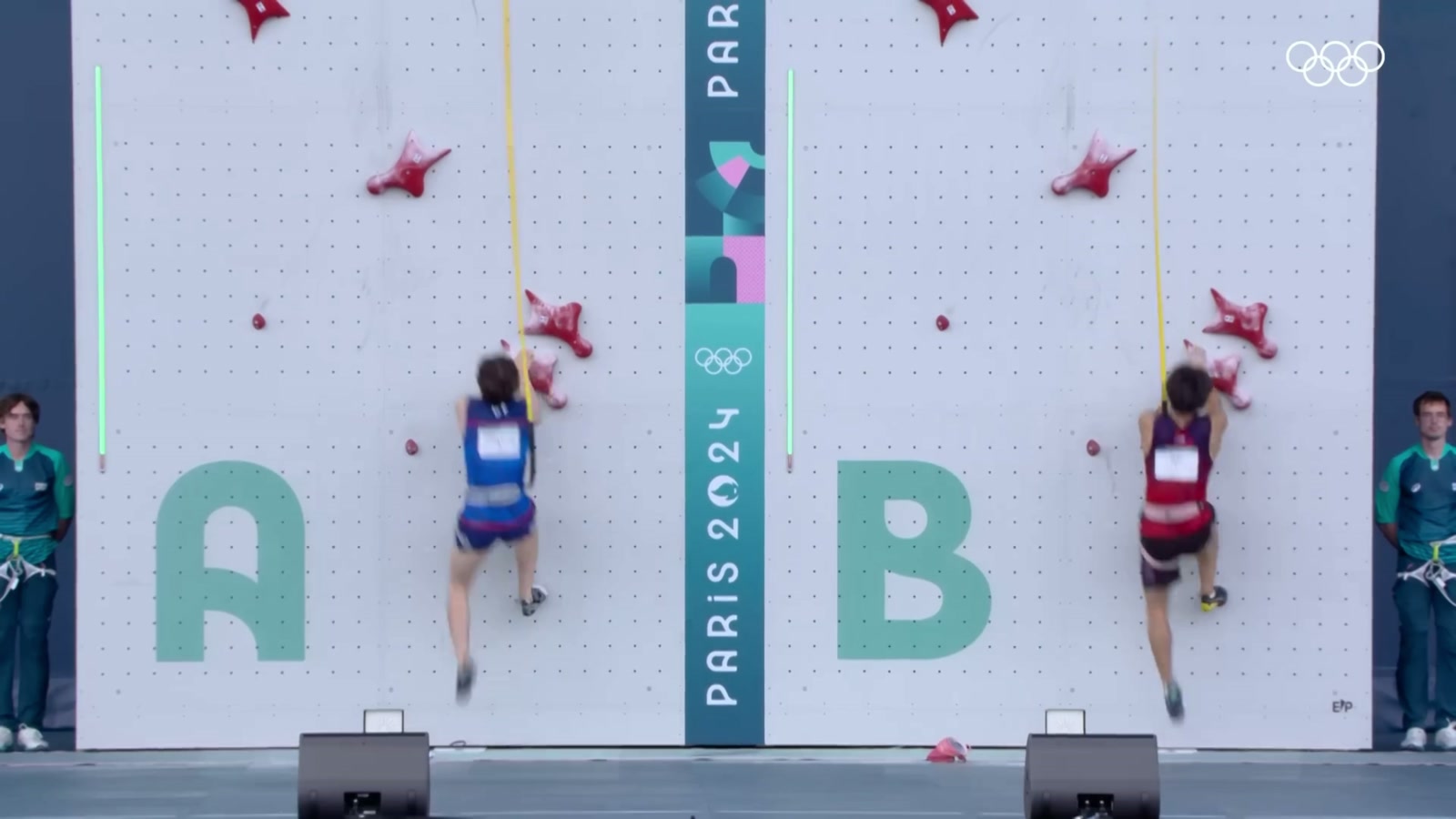
Two climbers racing side by side on the standardized speed wall at the Paris 2024 Olympics
Two lanes, one identical route: the standardized 15-meter wall at Paris 2024.
The rules

How a race actually works.

Simple to watch, brutal in the details. The margins are tiny: elite finals are often decided by less than a tenth of a second, so a clean run and a fast reaction off the pad can matter more than raw power.

Climbers stand with a foot on a pressure-sensitive start pad. When the tone sounds, releasing the pad starts your clock. Leave early and it's a false start, instant elimination, which is why reaction time is trained like a sprinter's.
In qualification, each athlete climbs both lanes once to record their fastest time. The fastest qualifiers advance, seeded against each other in a knockout bracket: two climbers race side by side, the winner advances, the loser is eliminated or drops to the small final. You're racing the person next to you and the clock at the same time.
A buzzer pad sits at the top of the 15m wall. Slap it to stop your clock. Times are measured to the thousandth of a second, and races are regularly decided by a few of them.
New for 2026, a four-lane head-to-head format debuted at the Madrid stop, more climbers racing at once, more spectacle, and a taste of where the sport is heading.
Olympic sport

From a niche race to an Olympic medal event.

Tokyo 2020

The debut

Sport climbing entered the Olympics as one combined event: Boulder, Lead, and Speed scores multiplied together to crown a single winner, mostly because new sports get very few medals. The format merged several different sports into one, and highly specialized speed climbers had no real way to compete.

Paris 2024

Speed gets its own medal

Paris granted Speed a standalone medal and combined the far more similar Boulder and Lead. Veddriq Leonardo and Aleksandra Mirosław took the first golds; Sam Watson took bronze and broke the world record. The sport exploded: records, registrations, viewership, and new standard walls around the world.

LA28

Three separate events

At the Los Angeles 2028 Games, Boulder, Lead, and Speed each get their own event. Speed returns to the top stage with the field faster than it has ever been.

How to get started

Honestly, anyone can speed climb.

A little climbing experience helps: if you can boulder or lead around the V3 level, you've got everything you need to start. From there, here's the pathway to getting fast.

Step 1

Start with the intro guide

Our free intro guide on Skool covers pretty much everything you need to know about getting started.

Step 2

Find a wall

Browse our global directory of speed walls mapped across the world. None near you? No problem, you can train without a wall until you reach one.

Step 3

Join the community

Hosted on Skool and built to be accessible to everyone: you can go from total beginner to established speed climber completely free. There are paid options for advanced training and serious athletes, but you can learn, train, and get better without ever touching them.

Step 4

Train and start enjoying it

Speed climbing has an amazing community and a sense of progression, competition, and excitement unlike most other sports. Once you start lowering your times, it's hard to stop.

Common questions

Speed climbing, quickly answered.

Speed climbing is, simply, climbing fast. Competition speed runs on a standardized 15-meter route that is always the same, unlike bouldering and lead, where every route is different. It's the only discipline with one memorized route where the entire game is doing it faster than everyone else.
Usually if you're athletic in any way, you can speed climb. The beautiful thing is that there's a 100% chance you'll be able to climb faster than your previous self if you work on getting better. The route is about 5.10c in climbing terms, but all the moves are pretty large and benefit from momentum, so it's actually easier to climb fast than slow.
Recreational climbers often reach the top in 12–20 seconds early on and steadily chip it down with technique. The world records stand at 4.54 and 5.99 seconds: targets to measure yourself against, not to expect on day one.
Yes. Speed was part of the Tokyo 2020 Olympics combined with boulder and lead in one event, because the Olympics only gives out so many medals to new sports. Fortunately that's no longer the case: speed got its own medal at Paris 2024, and boulder, lead, and speed will all be separate events at the LA 2028 Olympic Games.
Use our speed wall directory to see if there's an official one near you. If you know of a wall that isn't on there, please tell us and we'll add it.
Yes, somewhat. Climbing fast on a non-official wall is sometimes called "classic" speed climbing, because before the standardized route was adopted in 2007, the wall was random each time. See our beta guide for the route itself and our guide to training without a wall.
Yes, just make sure to clip in! The auto belay catches you automatically, so you can train alone. Speed climbing is a very safe sport (even compared to boulder or lead), since you never actually hit the ground in an uncontrolled way.
Nope! Anyone can speed climb. There are kids as young as 3 and crushers as old as 65. Youth climbers often use 10-meter routes of various types with extra holds, which is key for developing the muscles required for speed climbing, and it works for adults as well.
Next: learn the route

Get faster, faster.

Get your runs reviewed, learn the route from people who race it, and train alongside climbers chasing the same clock.

Join the Community

From the start, to the top, to your first PB, for free · Founded by Olympic medalist Sam Watson & coach Albert Ok

Join the Community