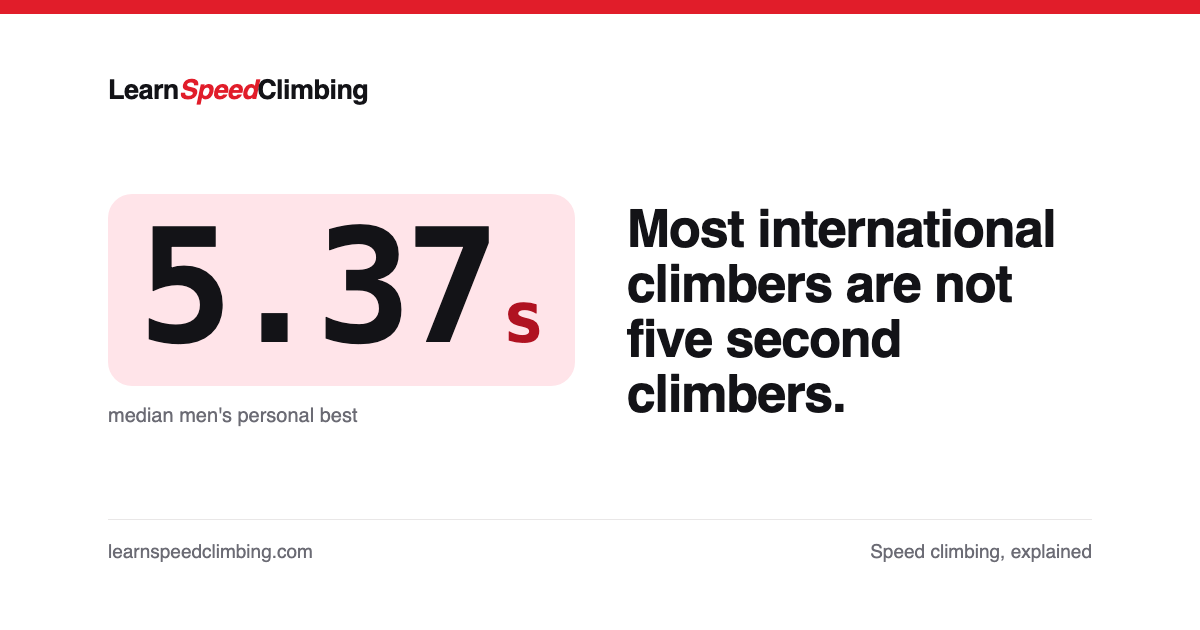
Everyone who times their first run wants to know the same thing: was that good? The problem is that almost nobody answers it with numbers. So we pulled the official personal best of every international speed climber we hold a record for, and looked at where the times actually land.
One caveat first, and it matters. This is the population of climbers who have competed at world level: 138 men and 112 women with an official personal best on the standardized 15m wall. It is not a sample of everyone who climbs. If you compare yourself to this group you are comparing yourself to people who fly to World Climbing Series events. Read the numbers with that in mind.
The distribution
| Men | Women | |
|---|---|---|
| World record | 4.54 | 5.99 |
| Top 10% of the field | 4.84 | 6.34 |
| Median international competitor | 5.37 | 7.50 |
| Bottom 10% | 6.65 | 10.41 |
The first surprise for most people is the median. The middle of the international field is 5.37 for men and 7.50 for women, not the 5-flat and 6-flat you might assume from watching finals. Broadcasts show you the eight fastest people in the world. They are not the field.
The second surprise is the spread. The slowest official times on record are over 20 seconds. Those are real international competitors, often the first athlete their country has ever sent, climbing on limited wall access. The distance from the median to the record is smaller than the distance from the median to the back of the field.
So what counts as good?
Here is the honest scale, blending the competition data above with what we see from recreational climbers:
- Over 20 seconds. A first session. Everyone starts here, including the people at the top of the table.
- 12 to 20 seconds. Normal for a recreational climber in their first weeks on the route. You are learning the sequence, not racing it.
- Around 10 seconds. You know the route. It is memorized and you are no longer thinking about where to reach.
- Sub-8. Genuinely fast for someone without a coach or a home speed wall. Most climbers who reach this did it with consistent route volume.
- Sub-7 for men, sub-9 for women. You are quick in any gym in the world.
- Sub-6 men, sub-7.5 women. You are in the range of the international field.
- Sub-5 and sub-6.5. Fewer than 20 nations on earth have ever had a climber this fast.
The gap between "I did the route" and "I raced the route" is enormous, and it is almost entirely technique. The route is graded around F6b, roughly 5.10c. The difficulty is not what is slowing you down.
Why comparing your gym time to a broadcast time is unfair
Two reasons that have nothing to do with you.
The wall. Times are only comparable on a certified 15m wall. A 10m wall, common at youth and regional events, produces a completely different number. Of the walls in our directory, only a fraction are confirmed full-height, and many are unconfirmed.
The timing. Official times come off a pressure pad and a touchpad, accurate to the thousandth. A phone stopwatch and a friend's reaction time is not the same measurement, and it usually flatters you by a few tenths.
If you want a number you can actually compare, you need a certified wall with a real timing system. Our wall directory lists the timing system for every venue we have confirmed one at.
The number that actually matters
Your last one.
The route never changes, which means your time six months ago and your time today measure exactly the same thing. That is unusual in climbing and it is the sport's best feature. You do not need to be near the international field for the number to be useful; you need to beat the person you were.
Practical version: film a run, time it properly, write it down, and repeat in a month. That single habit outperforms almost everything else a self-coached climber can do.
Where to go from here
Learn the route first. Accuracy is the ceiling for far more climbers than strength is, and you cannot be accurate on placements you have not memorized. Our beta map walks all 20 hand holds and 11 footchips, free.
Then find a wall you can measure on, and put your time on the board. The wall map carries verified runs alongside official competition times, so you can see exactly where you sit on the same wall other people are climbing.
And if you want your runs looked at by people chasing the same clock, the Skool community is free to join. Post a run, get it reviewed, find out which of your seconds are the cheapest to win back.
Getting into speed climbing? Learn with climbers chasing the same clock.
Join the Community →