World records are a bad measure of a sport. One athlete on one day tells you where the ceiling is, not what is happening underneath it.
So we measured the field instead. We hold 4,503 official competition runs with a date, a time and a category attached. For each year we took the twenty fastest and averaged them, which gives a stable read on elite depth rather than a single freak run.
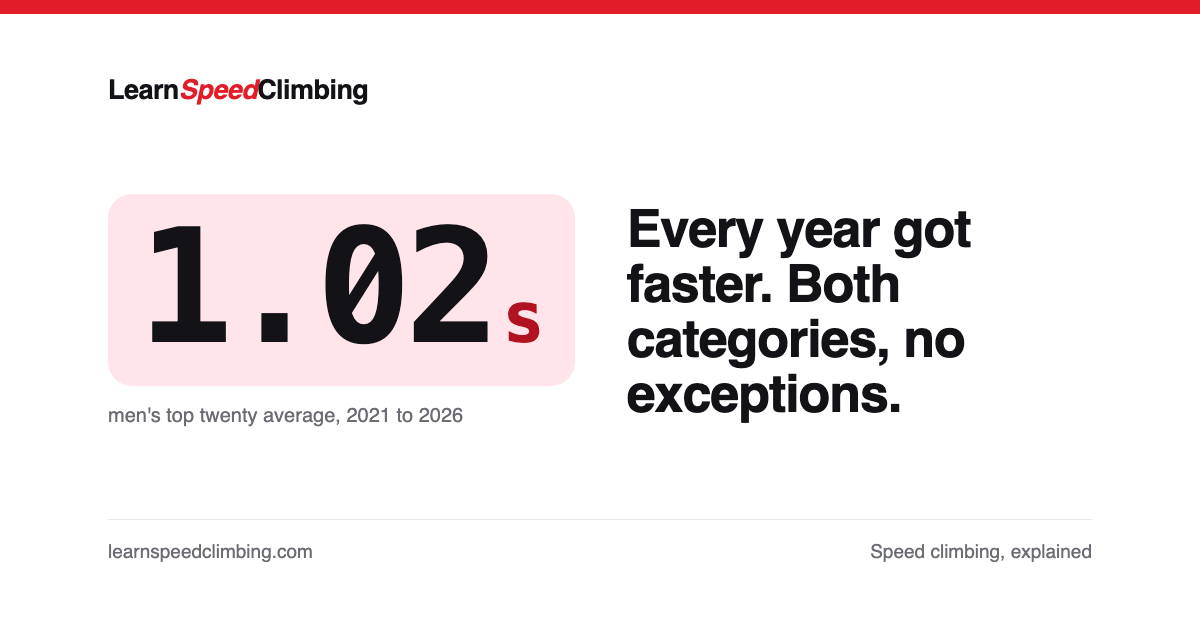
Every single year got faster. Both categories. No exceptions.
Men, twenty fastest runs averaged
| Year | Runs in data | Fastest run | Top 20 average | Change |
|---|---|---|---|---|
| 2021 | 430 | 5.000 | 5.854 | |
| 2022 | 350 | 5.420 | 5.712 | -0.143 |
| 2023 | 151 | 5.101 | 5.383 | -0.328 |
| 2024 | 225 | 4.954 | 5.222 | -0.162 |
| 2025 | 618 | 4.756 | 4.983 | -0.238 |
| 2026 | 870 | 4.546 | 4.839 | -0.144 |
Total drop: 1.015 seconds in five years. An average of 0.203 per year.
Women, twenty fastest runs averaged
| Year | Runs in data | Fastest run | Top 20 average | Change |
|---|---|---|---|---|
| 2021 | 192 | 7.823 | 8.361 | |
| 2022 | 112 | 7.589 | 8.083 | -0.278 |
| 2023 | 143 | 6.900 | 7.525 | -0.558 |
| 2024 | 178 | 6.301 | 7.260 | -0.265 |
| 2025 | 286 | 6.324 | 6.652 | -0.607 |
| 2026 | 417 | 6.078 | 6.373 | -0.279 |
Total drop: 1.987 seconds in five years. An average of 0.397 per year.
The finding that matters
Compare those rates to the world record.
The men's world record has fallen an average of 0.117 seconds a year across its whole history. The men's top-twenty field is falling at 0.203 a year, nearly twice as fast.
The field is closing on the record faster than the record is retreating. Elite speed climbing is compressing. What used to be a world-class time is becoming a semi-final time, and the gap between the best runner in the world and the twentieth best is smaller every season.
For the women the compression is even sharper. Two full seconds off the top-twenty average in five years, against a record falling at 0.158 a year.
That has a practical consequence. A time that would have made a final in 2021 does not qualify now. Athletes who improve steadily can still slide backwards in the standings, and that is not a failure of their training.
Read the caveats before you quote the numbers
This is our mined dataset of official runs, not a complete record of every competition ever held, and three things follow from that.
Sample size varies a lot by year. 2023 has 151 men's runs and 2026 has 870. A thin year is noisier, and 2023's unusually large drop should be read with that in mind.
Event mix varies. Which competitions are in the dataset for a given year affects the average. We restricted this analysis to 2021 onward precisely because earlier coverage is patchy: our 2014 data contains no elite events at all, so the raw numbers for those years describe our dataset rather than the sport.
Top-twenty is a choice. We used it because it is stable against a single exceptional run while still describing the elite end. A top-five average would be noisier and a median would describe a population that mixes national and world-level competition.
None of that changes the direction. Every year is negative in both categories, which is a hard thing to produce by accident.
Why it is happening
The same four causes that drove the record burst: speed became a standalone Olympic medal at Paris 2024 and specializing became a career, the Tomoa Skip propagated through the entire field within a season, training moved from climbing sessions to sprint methodology, and more certified walls exist to get route volume on.
The difference is that a record needs one athlete to nail one run. A field-wide drop of a full second needs the whole sport to get better, which is a much stronger signal about where the discipline is going.
Where this leaves you
If you are chasing a time, know that the target is moving. The standard for "fast" in this sport is not fixed, and a number that impressed people three years ago is ordinary now.
The route, though, has not changed since 2007, which means everything you learn is permanent and every time you have ever set is directly comparable to every time you will set. Start with the beta map, free, and put a run on the wall map to see where you sit.
Then keep watching. Every ratified record is on the world records page and the season lands live on the World Climbing Series calendar.
And if you want to be around people tracking the hundredths, the Skool community is free to join.
Getting into speed climbing? Learn with climbers chasing the same clock.
Join the Community →