Nobody who starts speed climbing wants a vague answer to this. So we measured it.
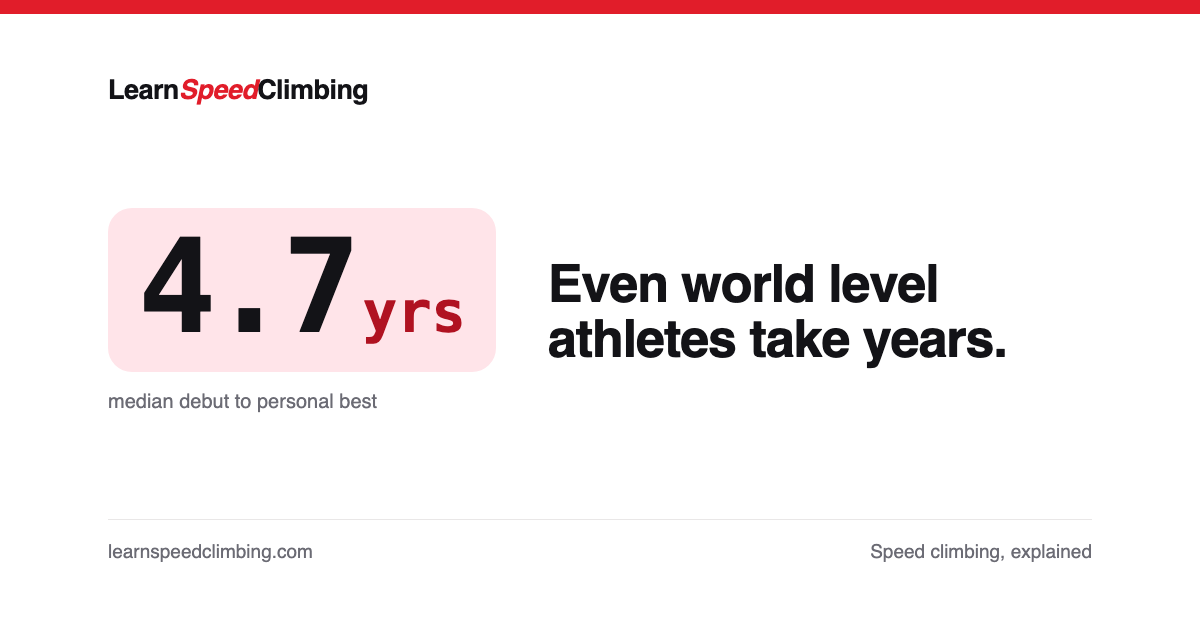
For every athlete where we hold both a competition history and an official personal best, we calculated the gap between their first recorded international result and the date of their fastest run. Across 245 athletes, the median is 4.7 years.
Narrow it to the fastest men in the field, those with a personal best under 5.20, and the number barely moves: 4.8 years.
What that number is, and is not
Be careful with it. This measures debut to peak among people who reached international competition. It does not measure beginner to fast, because we do not hold the date these athletes first touched a speed wall, and most had been climbing for years before their first international result.
So read it as the more interesting statement it actually supports: even among athletes good enough to compete internationally, the personal best arrives roughly five years after they show up. Almost nobody arrives at their ceiling. They climb toward it for half a decade in public, losing races the whole way.
The median career span in our data is six seasons, with the top ten percent competing fifteen or more. This is not a sport where people flash into their best and vanish.
Why this is good news for you
Three reasons.
The curve is long, so being slow now says nothing. If world-level athletes take five years from their debut to their best, a beginner being far off the pace in month three is meaningless information. The people you are comparing yourself to were also nowhere near their own best at that point.
The route never changes, so progress compounds. In bouldering, the problems reset and the thing you learned may not recur. In speed, every improvement to your beta is permanent and applies to every run you will ever do on any certified wall on earth. Nothing you learn expires.
Your improvement is measurable in a way most sports are not. A number today against a number six months ago, on the identical route, with identical holds. That feedback loop is why the sport is satisfying to grind at.
What actually determines your rate
Not talent, mostly. Three things:
Route volume. Time on the actual wall is the single biggest predictor of improvement. This is also the sport's real barrier, because certified walls are scarce. A wall two hours away, visited when you can, beats no wall by an enormous margin.
Accuracy work over strength work. Overshoot a hold and you spend time going too far, then time coming back. Even 0.3 seconds out and 0.3 back is 0.6 seconds gone, and no strength gain buys that back. Accuracy is the ceiling for far more climbers than power is.
Whether you review your runs. Film, compare against a reference, take one note, bring it to the next session. Self-diagnosis is slow and often wrong even for elite athletes, which is exactly why the footage matters: it removes the guessing.
A realistic timeline for a self-coached climber
With regular access to a certified wall and a deliberate approach:
- Sessions 1 to 3. Learning the sequence. Times over 20 seconds. Do not time yourself seriously yet.
- First month. The route is memorized. Somewhere in the 12 to 20 second range.
- Months 2 to 6. The steepest part of the curve. This is where most people find their largest single drop, and it comes from beta and accuracy, not fitness.
- Year 1 to 2. Sub-10, then chipping at it. Progress slows and becomes deliberate.
- Beyond. Tenths, then hundredths. The same shape the record progression shows at the top of the sport.
Without regular wall access the whole timeline stretches, and no amount of gym work substitutes. What off-wall training does is stop you losing ground and let you arrive at your next wall session ahead of where you left.
Start the clock properly
Learn the route first, because you cannot be accurate on placements you have never made. The beta map walks all 20 hand holds and 11 footchips, free.
Find somewhere to measure on. The wall directory lists height, lanes and timing system for every venue we have confirmed, which is what decides whether your number means anything.
Then put a time on the board and start the comparison that matters. The wall map carries community runs next to official competition times on the same walls.
And get your runs looked at. Five years is the median for people with coaches and national programmes behind them. If you are self-coached, other climbers reviewing your footage is the closest substitute, and the Skool community is free to join.
Getting into speed climbing? Learn with climbers chasing the same clock.
Join the Community →