In August 2011 the men's world record on the standardized route stood at 6.26. It is now 4.54. That is 1.72 seconds removed from a run that never lasted more than six, over fourteen years and 23 separate records.
The obvious question is where it stops. Here is what the progression actually shows.
The rate
Across the whole standardized era, the men's record has come down an average of 0.117 seconds per year. The women's record has fallen faster: 8.05 to 5.99 since 2013, 0.158 seconds per year, a total of 2.06 seconds.
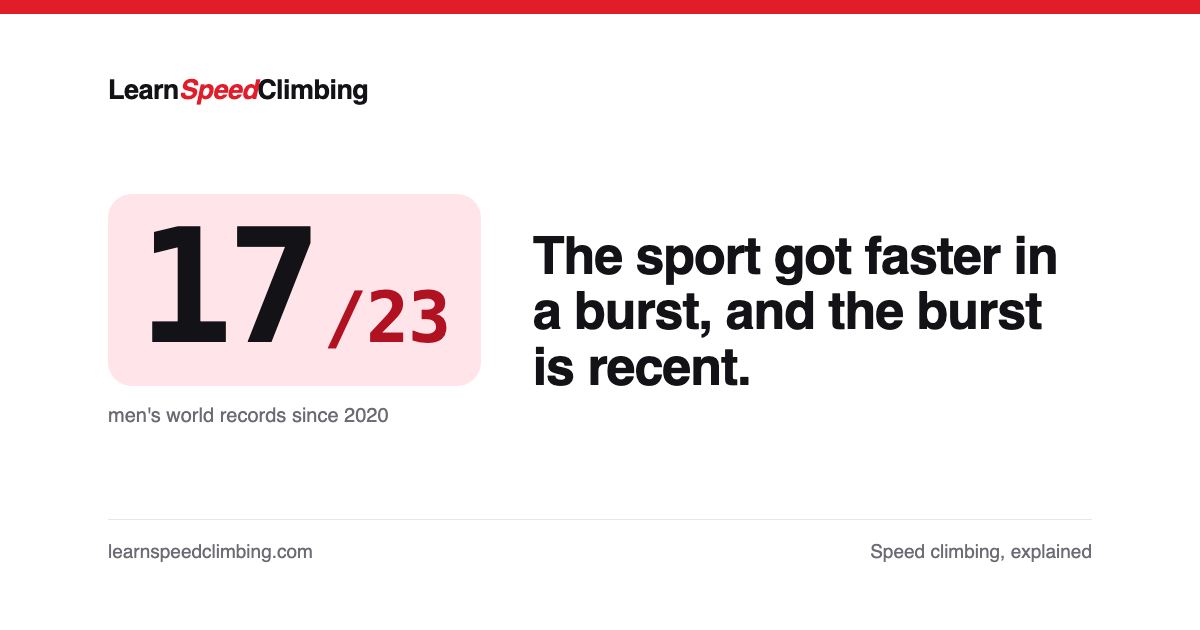
Those averages hide the important part. 17 of the 23 men's records were set after 2020. For the women it is 13 of 24. Three quarters of the men's record history has happened in the last quarter of the time.
The sport did not get gradually faster. It got faster in a burst, and the burst is recent.
Why the acceleration is real
Four things changed at roughly the same time.
Paris 2024 gave speed its own medal. Tokyo 2020 merged boulder, lead and speed into a single combined event, which meant a specialist had no path. When Paris split speed out, specializing suddenly made sense as a career. The field of people optimizing exclusively for this route grew quickly.
The beta improved. The Tomoa Skip removed a hold from the lower section for climbers who could execute it, and is now standard at the top. Beta discoveries propagate instantly in speed because everyone is climbing the same route: one athlete's solution is available to the entire world by the next competition.
Training got specific. Speed is trained like a sprint now, with reaction work, plyometrics and force development, rather than as a climbing session done quickly.
More certified walls exist. Volume on the actual route is the single biggest predictor of improvement, and there are simply more places to get it than a decade ago.
So where is the floor?
Nobody knows, and anyone who gives you a confident number is guessing. But the shape of the data suggests a few things.
Naive extrapolation is wrong. Continuing 0.117 seconds a year would put the men's record under four seconds around 2031 and at zero within four decades, which is obviously absurd. Records in every sport decelerate as they approach a physiological limit. Ours has not visibly started decelerating yet, which is itself notable.
The margins say we are getting close to something. Recent records fall by hundredths, not tenths. The step from 4.58 to 4.54 is a four-hundredth improvement. When records move in hundredths, the remaining headroom is usually measured in tenths, not seconds.
The women's record has more room. It is falling faster, from a higher number, with a field that has been fully professional for less time. The gap between the men's and women's records is currently about 1.45 seconds and it has been closing.
The route is the constraint. There is a minimum number of movements and a maximum useful force per movement. Twenty holds, 15 metres, five degrees of overhang. At some point the limit is the human body against a fixed geometry, and the fixed geometry does not negotiate.
What actually moves next
If you want to know where the next tenth comes from, watch three places.
The start. Reaction time off the pad is measurable, trainable and currently varies more between elite athletes than the climbing does.
The transitions. Not the moves, the joins between them. Elite runs differ from very good runs mostly in the moments where nothing spectacular is happening.
The top section. Deceleration into the buzzer is a real and common loss. Climbers who keep momentum into the pad gain time that costs nothing physically.
All three are technique, not strength. Which is the recurring lesson of this sport: past a moderate base, the ceiling is accuracy and timing rather than power.
Follow it as it happens
Every ratified record, oldest to newest, is on our world records page, and the full season with results as they land is on the World Climbing Series calendar.
If you want to watch the sport get faster with people who care about the hundredths, the Skool community is free to join. Records get broken during competition weekends, and it is a good place to be when they do.
Getting into speed climbing? Learn with climbers chasing the same clock.
Join the Community →